



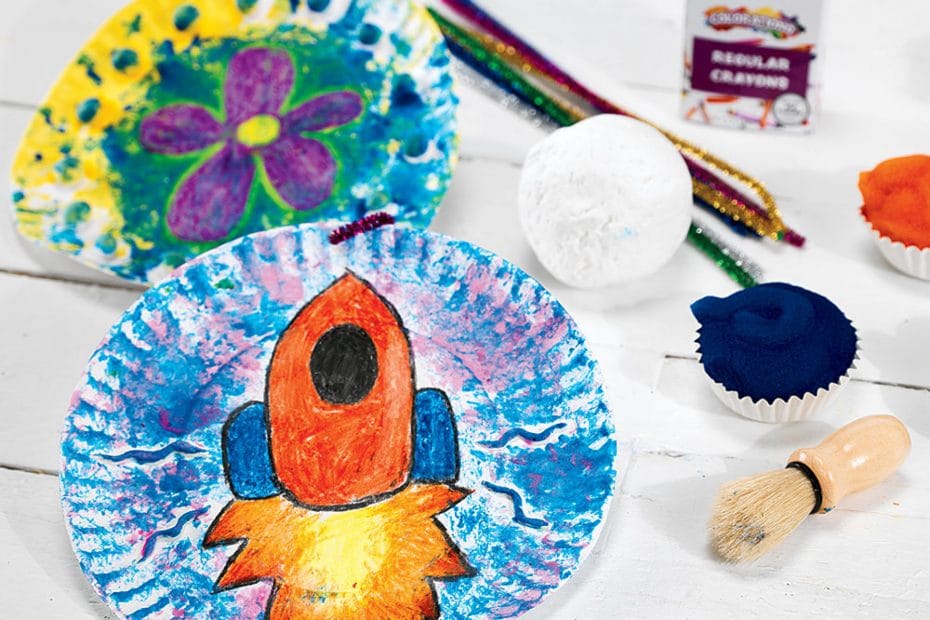
Intro
Combine art and science to teach about elements that resist one another! A perfect
introduction to the crayon-resist technique, this activity will also help children build
grasping and motor skills as they scrunch and grip paper towels for painting.
Set Up Ideas
You may wish to demonstrate a few samples of this artwork to give children ideas of the
many possibilities that can be created.
Let’s Get Started
Ensure that each child has a paper plate, crayons, foam paint and paper towels ready.
While foam paint is generally easy to manage, those paper towels may also prove handy at quickly cleaning up any accidental messes.
If this is the children's first time doing a crayon-resist type of activity, they may be
curious to learn how the crayon is not covered with the foam paint. Explain that wax is
not soluble, meaning it doesn't break down in water, and the paint they are using is
water-based.
Steps:
- Using crayons, draw onto a paper plate in very thick layers. Then, roll out small air-dry
putty coils and glue them onto the plate for added texture. - Make a palette of paint on a separate paper plate. Then, scrunch up the paper towels into
loose rag balls. Practice pitter-pattering by dipping the towel into paint and patting onto
paper in a light up-and-down motion. - After practicing the technique, repeat the process of dipping a scrunched paper towel in
paint and pitter-pattering foam paint onto the crayon drawing, covering all areas. - Wipe off any excess foam paint with a paper towel. Rub or polish the crayon area so that
all white spaces are filled. Finally, punch a hole and hang with cord.